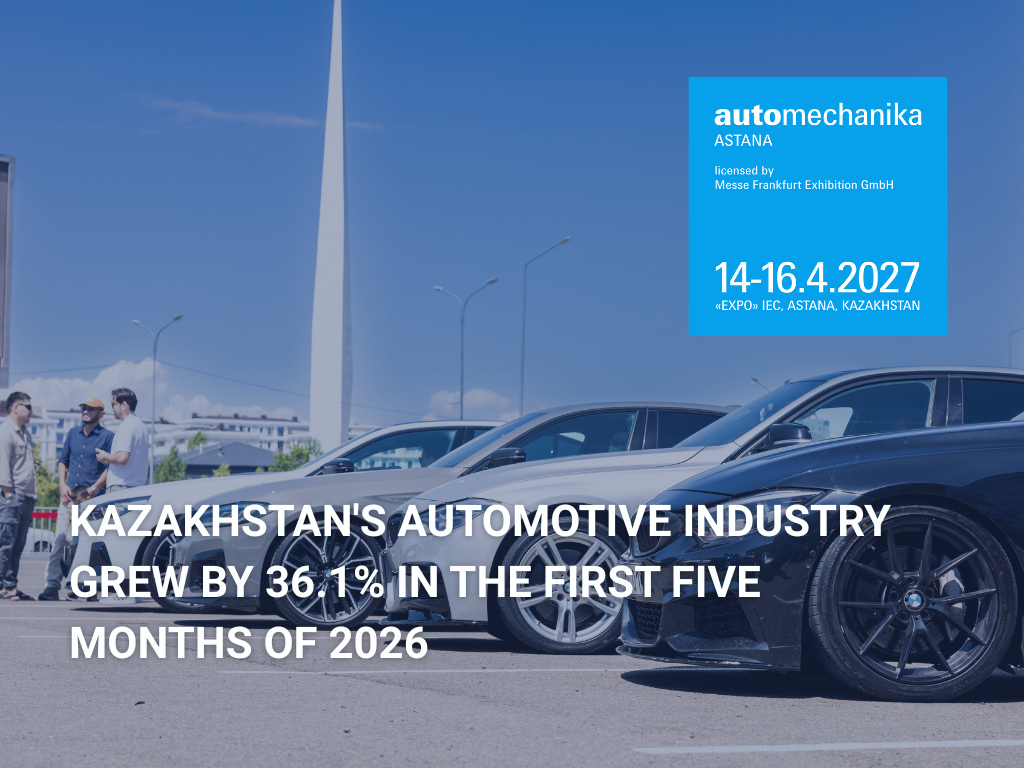
Kazakhstan's automotive industry continues to demonstrate strong growth. According to the Bureau of National Statistics of the Republic of Kazakhstan, a total of 78,580 vehicles and equipment units were produced between January and May 2026, including passenger cars, trucks, buses, special-purpose vehicles, trailers, and semi-trailers. This represents a 36.1% increase compared to the same period in 2025.
In May 2026 alone, Kazakh manufacturers produced 15,178 units, marking a 41.7% year-on-year increase compared to May 2025.
In value terms, the output of motor vehicles, trailers, and semi-trailers reached KZT 932.9 billion during the first five months of the year, up 15.5% year-on-year. Today, the automotive industry accounts for 41.6% of Kazakhstan's total mechanical engineering sector.
During January–May 2026, Kazakhstan produced:
According to Anar Makasheva, President of the Kazakhstan Automotive Union, the development of automotive component manufacturing around vehicle assembly plants is driving localization, attracting investment, creating new jobs, and strengthening technological capabilities. She noted that the implementation of the automotive cluster strategy outlined by the President of the Republic of Kazakhstan is becoming a key driver of the industry's continued expansion.
Among manufacturers, Allur remained the country's largest producer with 27,911 vehicles assembled during the reporting period. It was followed by the new Astana Motors Manufacturing Kazakhstan (AMMKZ) plant with 21,478 vehicles, Hyundai Trans Kazakhstan with 16,161 vehicles, and Kia Qazaqstan with 8,059 vehicles.
In the commercial vehicle segment, the strongest production growth was recorded by QazTehna (+82.3%), Hyundai Trans Almaty (+185.8%), and Daewoo Bus Kazakhstan (+230%).
Among domestically produced vehicle brands, Hyundai led the market with 16,131 vehicles, followed by Chevrolet (14,996) and Kia (9,209). Significant production volumes were also recorded by Changan, Chery, Haval, Jetour, JAC, Geely Galaxy, and Tank.
The continued growth of Kazakhstan's automotive industry is driving increasing demand for advanced technologies, automotive components, manufacturing equipment, and vehicle service solutions. These sectors remain at the core of Automechanika Astana, which brings together manufacturers, suppliers, distributors, and automotive professionals from Kazakhstan, Central Asia, and international markets.
Automechanika Astana 2027 will once again serve as the region's leading platform for discussing market trends, showcasing innovative technologies, and establishing new business partnerships amid the sustained growth of Kazakhstan's automotive industry.
Source: Kazakhstan Automotive Union (KAU).
In May 2026 alone, Kazakh manufacturers produced 15,178 units, marking a 41.7% year-on-year increase compared to May 2025.
In value terms, the output of motor vehicles, trailers, and semi-trailers reached KZT 932.9 billion during the first five months of the year, up 15.5% year-on-year. Today, the automotive industry accounts for 41.6% of Kazakhstan's total mechanical engineering sector.
During January–May 2026, Kazakhstan produced:
- 73,122 passenger cars (+39.7%)
- 2,396 trucks (-13.1%)
- 1,281 buses (+35.3%)
- 297 special-purpose vehicles (-3.9%)
- 1,484 trailers and semi-trailers (+4.7%)
According to Anar Makasheva, President of the Kazakhstan Automotive Union, the development of automotive component manufacturing around vehicle assembly plants is driving localization, attracting investment, creating new jobs, and strengthening technological capabilities. She noted that the implementation of the automotive cluster strategy outlined by the President of the Republic of Kazakhstan is becoming a key driver of the industry's continued expansion.
Among manufacturers, Allur remained the country's largest producer with 27,911 vehicles assembled during the reporting period. It was followed by the new Astana Motors Manufacturing Kazakhstan (AMMKZ) plant with 21,478 vehicles, Hyundai Trans Kazakhstan with 16,161 vehicles, and Kia Qazaqstan with 8,059 vehicles.
In the commercial vehicle segment, the strongest production growth was recorded by QazTehna (+82.3%), Hyundai Trans Almaty (+185.8%), and Daewoo Bus Kazakhstan (+230%).
Among domestically produced vehicle brands, Hyundai led the market with 16,131 vehicles, followed by Chevrolet (14,996) and Kia (9,209). Significant production volumes were also recorded by Changan, Chery, Haval, Jetour, JAC, Geely Galaxy, and Tank.
The continued growth of Kazakhstan's automotive industry is driving increasing demand for advanced technologies, automotive components, manufacturing equipment, and vehicle service solutions. These sectors remain at the core of Automechanika Astana, which brings together manufacturers, suppliers, distributors, and automotive professionals from Kazakhstan, Central Asia, and international markets.
Automechanika Astana 2027 will once again serve as the region's leading platform for discussing market trends, showcasing innovative technologies, and establishing new business partnerships amid the sustained growth of Kazakhstan's automotive industry.
Source: Kazakhstan Automotive Union (KAU).