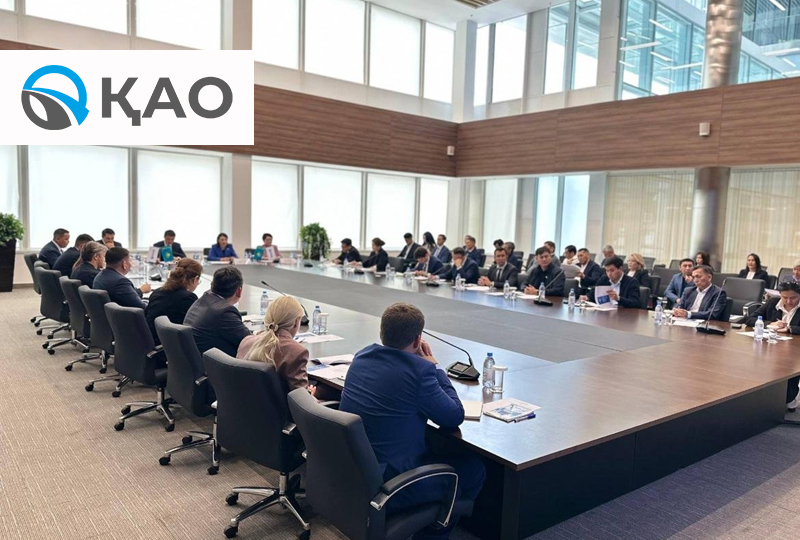
In Almaty and Astana, the Kazakhstan Automobile Union held a roundtable dedicated to financing joint projects within the Eurasian Economic Union (EAEU). The discussion brought together representatives of government bodies, the Eurasian Economic Commission (EEC), the National Chamber of Entrepreneurs "Atameken," deputies of the Mazhilis of Kazakhstan, industry associations, international experts, and more than 200 Kazakhstani companies.
The key topic was the new EEC mechanism that subsidizes interest rates on loans and credits attracted by enterprises from EAEU member states to implement joint projects. A mandatory condition for participation is industrial cooperation: at least three companies from different EAEU member states must be involved. A list of eligible sectors is published on the EEC website. Participants were also presented with examples of the first approved projects, which are already showing results.
Gohar Barseghyan, Minister for Industry and the Agro-Industrial Complex of the EEC, emphasized:
"It is important that this mechanism works in practice, not just on paper – it allows enterprises to access preferential financing and expand production. Today we already see the first projects that have received support and begun implementation."
Deputy Minister of Industry and Construction of Kazakhstan, Olzhas Saparbekov, noted that the mechanism had been tested in pilot projects and is now available to a wide range of companies:
"The main task now is to ensure that as many Kazakhstani enterprises as possible can benefit from it. Most importantly, it should help our manufacturers launch new productions at lower costs."
President of the Kazakhstan Automobile Union, Anar Makasheva, stressed the importance of informing businesses:
"Our key task is to show domestic enterprises how this mechanism works. So far, there are not many projects from Kazakhstan, largely due to a lack of information. Thanks to detailed explanations from the EEC, we expect more Kazakhstani companies to join cooperative projects and take advantage of the opportunities provided."
All proposals and comments voiced during the discussion were recorded by EEC representatives for further work.
For Kazakhstani companies, this instrument opens up real prospects – from reducing loan costs to expanding production and entering EAEU markets. In this context, industry exhibitions play a special role, serving as platforms for finding partners for cooperative projects. Automechanika Astana 2026 will be one of the key events, bringing together manufacturers, suppliers, and distributors of auto components from across the region and acting as a starting point for new joint initiatives.
The key topic was the new EEC mechanism that subsidizes interest rates on loans and credits attracted by enterprises from EAEU member states to implement joint projects. A mandatory condition for participation is industrial cooperation: at least three companies from different EAEU member states must be involved. A list of eligible sectors is published on the EEC website. Participants were also presented with examples of the first approved projects, which are already showing results.
Gohar Barseghyan, Minister for Industry and the Agro-Industrial Complex of the EEC, emphasized:
"It is important that this mechanism works in practice, not just on paper – it allows enterprises to access preferential financing and expand production. Today we already see the first projects that have received support and begun implementation."
Deputy Minister of Industry and Construction of Kazakhstan, Olzhas Saparbekov, noted that the mechanism had been tested in pilot projects and is now available to a wide range of companies:
"The main task now is to ensure that as many Kazakhstani enterprises as possible can benefit from it. Most importantly, it should help our manufacturers launch new productions at lower costs."
President of the Kazakhstan Automobile Union, Anar Makasheva, stressed the importance of informing businesses:
"Our key task is to show domestic enterprises how this mechanism works. So far, there are not many projects from Kazakhstan, largely due to a lack of information. Thanks to detailed explanations from the EEC, we expect more Kazakhstani companies to join cooperative projects and take advantage of the opportunities provided."
All proposals and comments voiced during the discussion were recorded by EEC representatives for further work.
For Kazakhstani companies, this instrument opens up real prospects – from reducing loan costs to expanding production and entering EAEU markets. In this context, industry exhibitions play a special role, serving as platforms for finding partners for cooperative projects. Automechanika Astana 2026 will be one of the key events, bringing together manufacturers, suppliers, and distributors of auto components from across the region and acting as a starting point for new joint initiatives.